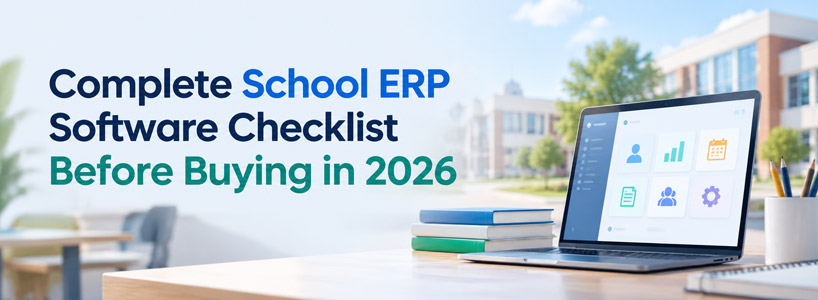
Complete School ERP Software Checklist Before Buying in 2026
Teachers, students and parents have always worked together in education and with school administration increasing the responsibilities increase nowadays. Taking attendance, collection of fees, examinations, parent communication, and managing records usually takes up precious time that could be utilized in enhancing learning. The most suitable school ERP software can assist institutions in handling all these functions using a single platform, which decreases the ratio of manual work, enhances accuracy and saves time.
You may be running a school, college, or coaching institute, but the correct ERP system can make the day-to-day work easier and help in better coordination between departments. The education enterprise resource planning market is expanding at a global level with more institutions going online to enhance their efficiency and decision-making process.
What Is School ERP Software?
School ERP (Enterprise Resource Planning) software is a centralised, combined, and digital platform used to control all fundamental operations of a school, all under a single roof. Instead of having separate tools to conduct admissions, attendance, fees collection, examinations, human resources, and communication, a school ERP makes all these come together in a single and unified system where data is easily passed between modules.
Consider it an operating system for your school. From the time an aspiring student sends an inquiry until the day they get their final report card, all the interactions, records, payments, and milestones, academic-wise, are recorded and can be accessed in real time.
Why Schools, Colleges & Coaching Institutes Need the Best School ERP Software
Educational institutions of all types K-12 schools, colleges, higher education, vocational institutes, and coaching centres all work together with a similarly sets of operational challenges that cannot be managed adequately at scale with a manual system:
- Keeping proper records of hundreds or thousands of students on a timely basis.
- Organizing fluidly across the academic departments, finance, Hr and administration.
- Having parents up-to-date without all the staff calls and emails to parents.
- On-demand generation of reports on compliance, examination findings and financial summaries.
- Running fee collection, payroll and accounting with accuracy and complete transparency.
The best school ERP software streamlines scheduling, fee management, HR, payroll, and administration through one integrated platform for every institution.
Core School ERP Features That Every Institution Should Prioritise
Not all platforms are built the same. When evaluating the best school ERP software for your institution, the following core school ERP features are non-negotiable. Platforms that compromise on even one of these areas will create friction and data gaps down the line.
1. Student Information System & Admissions Management
A good school ERP is composed of the Student Information System (SIS). It keeps its student records, personal information, academic history, guardian information, documents and behavioural records in a single, secure database that can be searched. This core is directly linked with the admissions module, which enables institutions to process online applications, monitor their status in a customisable pipeline and auto-enrol confirmed students with the push of a button.
2. Attendance Management Directly Linked to Student Records
The attendance management within the ideal software is much more than the names taken on a paper register. The platform contributes to mobile app/biometric support of daily/period attendance marks. When a student is recorded absent, the system will automatically look up his/her student profile to find out the parent contact numbers and either send them a real-time SMS or in-app notification.
3. Fee Management Seamlessly Connected to Accounting
Collection of fees manually is one of the most time-consuming and inaccurate activities in any educational institution. The optimal ERP software has automated the entire fee cycle: creating invoices based on customizable fee plans, sending automated payment notices, accepting online payments via various integrated gateways, and reconciling all collections with the accounting system.
4. Examination Management All the Way Through to Report Cards
There is much more to examination management than there is to test dates. The integrations included in the best ERP software support the entire examination process: generating exam timetables, avoiding invigilators, allowing subject teachers to enter marks online or offline, automatically compiling grades by custom grading structures, and producing formatted, institutionally branded report cards at the touch of a button.
5. Parent Communication Fully Integrated with School Administration
The communication between the parents and the teacher no longer depends on two parent-teacher meetings per year. An excellent this software solution has an integrated parent portal and mobile application that will help establish real-time communication between parents and the school administration.
Parents will be able to check the attendance records of their child, the fee status, as well as the dates of their examinations, and their report cards can be downloaded and instant messages about school events and holidays, as well as fee reminders, can be provided.
6. HR, Payroll & Staff Management
The same should be addressed to the staff management as it is to the student management. The overall school ERP system monitors employee information, such as account and qualification, departmentalisation, attendance records, and leave applications.
Payroll processing, which constitutes calculation of payroll, statutory deductions, management of arrears as well as generation of payslips automatically based on the attendance data, does away with manual calculation using the spreadsheet and virtually does away with payroll errors.
How to Choose the Best School ERP Software for Your Institution
That said, with plenty of options in the market today, selecting the best school ERP software to implement in your organization must be approached methodically, with needs first. In addition to the school ERP checklist shown above, remember to have the following decision-making factors at the top of the list:
- Cloud vs. On-Premise: Cloud-based school ERP solutions come with remote accessibility, automatic updates, reduced initial costs of infrastructure and high disaster recovery. Most schools, colleges and coaching institutes will be using cloud deployment as their preferred option in 2026.
- Scalability: Scalability is important whether your institution needs to run multiple branches or is expanding its size; the platform should be user-friendly so that it can manage many campuses with only a single instance of the software.
- Mobile Accessibility: Accessibility to important information via smartphones has become a need amongst parents, teachers, and students. Vital feature, not premium option, should be dedicated iOS and Android apps that are notified of updates in real time using push technology.
- Standard Data Security: The platform should provide data in transit and data at rest with end-to-end encryption, role-based access control (only a teacher can access the data related to their classes), and automated backups to the cloud with specified recovery time goals.
- Features: Ensuring the platform is integrated with both biometric devices to track attendance, popular payment gateways to collect fees, the existing learning management systems (LMS), and third-party accounting software it is used with.
Conclusion
The challenge of modernising school management and moving away from manual school management to digital management has become a reality. The best school ERP software saves a lot of paperwork, enhances the administration and assists schools, colleges, and coaching institutes to make informed decisions and reinforce parent involvement.
Attributes like student information, attendance, fee administration, examinations, and communication bring a combination of simplifying day-to-day operations. Check this school ERP checklist to compare vendors, ask for a live demo, and consider each platform closely. The idea is to select the most appropriate software that fits your needs and augments your efficiency and future sustainability.
Frequently Asked Questions (FAQs)
Q1. What is the difference between school ERP software and a basic school management system?
- This software integrates admissions, attendance, fees, HR, payroll, examinations, and communication into one platform, unlike basic management systems with limited functions.
Q2. Can this software be used by coaching institutes?
- Yes. This software supports coaching institutes by managing batches, fee structures, attendance, examinations, and student performance from a single platform.
Q3. How long does it take to implement school ERP software?
- Implementation usually takes 48 weeks for small institutions and 24 months for larger organisations, depending on data migration and training requirements.
Q4. Is the same school ERP checklist suitable for every institution?
- Core requirements remain the same, but schools, colleges, and coaching institutes should prioritise features according to their academic and administrative needs.
Q5. How does school ERP software protect student data?
- Reliable ERP systems secure data through encryption, role-based access, regular backups, and security controls that help protect sensitive student and staff information.
Add a Comment
Your email address will not be published. Required fields are marked *
Categories
Popular Posts
Complete School ERP Software Checklist Before Buying in 2026
 Nisha
 Oct 27, 2026

How School ERP Software Saves 20+ Hours Every Week for Teachers